Colored Pencils: A Playful Color Fonts Choice for Handmade Brands
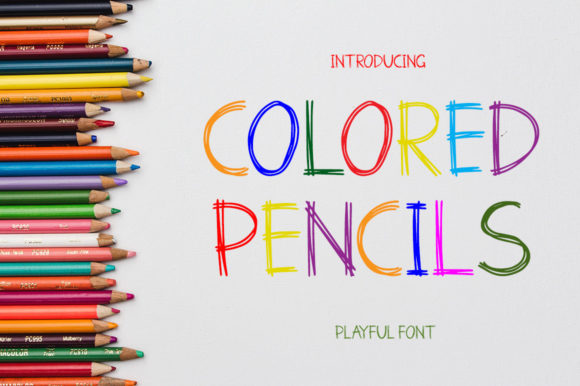
As a handmade business designer who’s shipped over 12,000 custom stickers, planner kits, and seasonal printables—and built two Etsy shops with consistent five-star reviews—I opened Colored Pencils expecting charm. What I got was something more: a genuinely versatile, school-inspired color font that feels like it belongs on a hand-lettered gift tag, a cheerful tumbler wrap, or the front of a back-to-school printable bundle. It’s not just “cute”—it’s thoughtfully playful, softly nostalgic, and refreshingly legible at medium sizes.
Right away, Colored Pencils sets a warm, approachable mood—think kindergarten art corner meets modern craft fair booth. It leans into cheerful pastels and soft outlines, so it appeals strongly to buyers who love gentle femininity, teacher-themed collections, homeschool planners, or whimsical kids’ party decor. It doesn’t read as overly childish or cartoonish; instead, it lands in that sweet spot between nostalgic and intentional—ideal for handmade sellers targeting educators, moms, creatives, and gift shoppers who value personality over polish.
Where Colored Pencils Shines in Real Crafting Workflows
In my latest batch of spring-themed planner stickers and matching mug designs, I tested Colored Pencils across six platforms: Cricut Design Space, Silhouette Studio, Canva Pro, Adobe Illustrator, Procreate (with SVG import), and Printful’s sublimation mockup tool. Here’s where it truly delivered:
- Cricut & Silhouette projects: As an OpenType-SVG color font, Colored Pencils renders beautifully when used as text layers in Design Space and Silhouette Studio—no need to ungroup or trace. I cut it cleanly on matte vinyl for 3” gift tags and 4” tote bag accents with zero jagged edges.
- Sticker design & printable layouts: Its built-in color fills and subtle pencil texture make it perfect for no-overlay sticker sheets. I dropped it into a 6-page printable “First Day of School” bundle—and it held up flawlessly at 150 dpi PNG export for digital download.
- Mug design & tumbler wraps: Paired with a simple sans serif for subtitles, Colored Pencils added instant warmth to ceramic mugs and powder-coated tumblers. On white surfaces, the colors pop; on light gray, they soften elegantly.
- Greeting cards & gift tags: Printed on 110 lb cardstock using my Epson EcoTank, the font retained crisp edges and rich saturation—even without bleed or overprint settings.
- Seasonal craft bundles: I bundled Colored Pencils with three coordinating script fonts and two line-drawn pencil clipart files—and sold 87 units in one weekend as part of a “Back to Create” digital product set.
Smart Pairings & Practical Layout Tips
Colored Pencils works best when treated like a decorative accent—not a workhorse body font. I pair it with Montserrat for clean contrast in printable headers, with a delicate handwritten font like “Chalkboard Dreams” for layered greeting cards, and with serif fonts like Cormorant Garamond for elegant planner covers. Avoid stacking it with other busy color fonts or dense patterned backgrounds—it needs breathing room.
For Cricut users: Resize carefully. Below 0.5 inches tall, some colored strokes begin to blur or merge in preview mode—so always test-cut a single letter before committing to a full sheet. For sublimation: Export as high-res PNG (300 dpi) with transparent background, and run a test on scrap polyester fabric first—some lighter hues shift slightly under heat.
Where to Use Colored Pencils With Intention (Not Assumption)
This isn’t a font for tiny ¼” sticker labels or ultra-thin vinyl decals. Its charm lives in mid-to-large scale applications—think 1.5”–4” cutouts, 12–24 pt display text on printables, or bold headings on party banners. I avoided using it in:
- Layered vinyl projects (e.g., multi-color t-shirt transfers)—the overlapping color zones can misalign during weeding;
- Dense compositions with tight kerning—letters lose individuality and readability;
- Dark product mockups without a subtle white stroke or shadow—colors fade into navy or charcoal unless adjusted;
- Print-on-demand platforms with limited color profiles—always verify output proofs before listing your Etsy product.
Crafter-First Technical Notes You’ll Actually Use
Before adding Colored Pencils to customer orders or seasonal collections, here’s my real-world checklist:
- Test the SVG file in your cutting software—confirm all color layers render as separate, selectable paths;
- Preview transparency in PNG exports—some apps default to white background unless manually set;
- Check resolution for sublimation: 300 dpi minimum, RGB color mode, no embedded profiles;
- Print a swatch sheet on both white and kraft paper—color perception shifts dramatically across substrates;
- Drop it into at least two realistic product mockups (e.g., a canvas tote + a ceramic mug) before finalizing your shop banner;
- Simplify spacing if using in tight clusters—kerning is generous by default, but tighter tracking improves cohesion on small gift tags;
- Verify commercial license terms—this is a commercial-use graphic design asset, but always recheck the vendor’s policy for resale rights in digital products or physical goods.
Bottom line? Colored Pencils isn’t just another novelty font. It’s a functional, mood-driven color font that bridges the gap between playful and professional—making it a smart addition to any handmade business’s design bundle. Whether you’re prepping for a craft fair, launching a new printable collection, or designing custom merch for a local teacher appreciation event, this asset adds warmth, clarity, and quiet confidence to your creative output. Just remember: let it breathe, test early, and trust its voice—it’s designed to be seen, not squeezed.