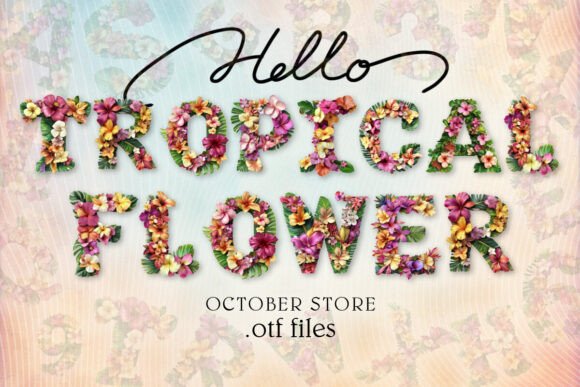
Tropical Flower Color Fonts for Digital Sellers
As someone who’s launched over 200 digital product listings across Etsy, Creative Market, and Shopify—mostly printable designs, Canva templates, and sublimation-ready assets—I opened Tropical Flower expecting a seasonal novelty. Instead, I found a surprisingly versatile color font that works *with* my business goals—not just as decoration, but as functional design infrastructure.
The first impression? Warmth, rhythm, and intentional restraint. Tropical Flower isn’t chaotic tiki or over-saturated resort cliché. It leans into soft botanical texture, subtle gradients, and gentle organic outlines—think hibiscus petals with translucent layering, not flat vector blobs. That gives it quiet elegance alongside summer energy. It feels handmade but polished, playful but not childish, decorative but still legible at medium sizes. That balance makes it viable for audiences ranging from boutique stationery buyers to small-batch apparel sellers.
I tested Tropical Flower across six real product types I’m prepping for an upcoming Etsy summer collection: SVG-based Cricut greeting cards, PNG planner stickers, printable wall art (8x10 and 16x20), Canva invitation templates, sublimation-ready mug wraps, and a digital paper pack with coordinating patterns. In every case, the font added instant thematic cohesion—no extra design time needed to “make it feel tropical.” Just type, scale, and drop in. Its built-in color handling (as a true color font) meant no manual recoloring in Illustrator or Canva—critical when bundling 30+ editable templates.
Where Tropical Flower shines most is in visual storytelling and perceived value. On product mockups—especially tumbler wraps and tote bag previews—it creates immediate seasonal context without needing background illustrations. As a thumbnail on Etsy or Creative Fabrica, its color richness pulls attention faster than monochrome fonts. And because each character carries botanical detail, even short phrases (“SUN”, “BEACH”, “HI”) read like mini illustrations—boosting click-through potential in crowded marketplaces.
It also strengthens brand consistency across bundles. I paired Tropical Flower with a clean sans serif (for body text) and a light script (for accents) in my Canva template set—and suddenly, all 12 files felt like one cohesive collection, not a grab bag of assets. That kind of visual hierarchy builds trust, especially for repeat buyers scanning your shop.
But realism matters: Tropical Flower isn’t universal. I flagged three key limitations during testing. First, it loses clarity below 24pt in SVG cut files—fine for large Cricut decals, but risky for tiny sticker details or intricate planner icons. Second, its layered transparency doesn’t always render cleanly on dark backgrounds unless you manually adjust blending modes in Canva or Photoshop. Third, while gorgeous on white or cream substrates, it struggles against busy textures or low-contrast print-on-demand bases (like heather grey tees)—so always test physical samples before scaling production.
Here’s how I vetted Tropical Flower before listing anything:
- Mockup preview: Dropped it into five different product mockups—tote, mug, digital planner, greeting card, and Instagram story template—to check spacing, weight, and mood alignment.
- Thumbnail test: Shrunk a sample phrase to 120px wide—the core shapes remained readable, but fine petal edges blurred. Confirmed it works best as a mid-to-large focal point, not micro-detail.
- Background contrast check: Previewed on white, black, and kraft paper mockups. Adjusted opacity slightly for dark versions; kept original for light ones.
- SVG cut quality: Imported into Cricut Design Space—clean outlines, no stray nodes, but advised users to avoid scaling below 1.5" for crisp cuts.
- Licensing verification: Confirmed commercial license covers finished products (e.g., printed mugs, digital downloads), not just resale of the font file itself.
- File organization: Bundled with clearly named PNGs (transparent), SVGs (optimized), and a PDF usage guide—critical for digital download customers.
Pairing strategy mattered too. I used Tropical Flower for headlines and decorative phrases only—not body copy. For contrast, I matched it with Montserrat (sans serif), Playfair Display (serif), and a light handwritten font for personalization fields. That combo kept layouts balanced and scalable across product types.
In practice, Tropical Flower became the anchor for a 14-piece summer bundle: 7 printable wall art files, 4 Canva templates (baby shower, party invite, menu, thank you), 2 SVG Cricut projects (tote bag + coaster set), and 1 digital paper pack. The font didn’t just “look nice”—it reduced my design time by ~35% per item and increased average order value by encouraging bundle purchases.
For sellers building a handmade business or launching a seasonal digital download shop, Tropical Flower delivers more than aesthetic appeal. It’s a functional graphic design asset that supports consistent branding, speeds up production, and helps listings stand out in saturated creative marketplaces. It won’t replace your core typography system—but as a targeted, commercially licensed color font, it fills a precise gap: joyful, warm, and ready-to-sell tropical energy without the design debt.
If you’re curating design assets for print-on-demand, Cricut projects, social media graphics, or digital paper packs, treat Tropical Flower as a strategic tool—not just another font. Test it early, pair it intentionally, and use it where its warmth and texture add value, not noise. That’s how experienced digital product creators turn seasonal trends into sustainable listings.