Cowboy Leather Alphabet: Color Fonts for Authentic Local Branding
As a brand designer who’s helped over 70 small businesses refine their visual identity—from artisanal candle makers in Asheville to family-run coffee roasters in Portland—I recently evaluated Cowboy Leather Alphabet for a real-world project: rebranding “Sage & Saddle,” a handmade leather-and-botanical skincare line based in Santa Fe. What struck me first wasn’t just the texture or the western motif—it was how immediately legible, tactile, and intentional it felt. This isn’t a novelty font tossed into a Canva template. It’s a graphic design asset built for emotional resonance and physical presence.
A Typeface That Smells Like Cedar and Sun-Baked Leather
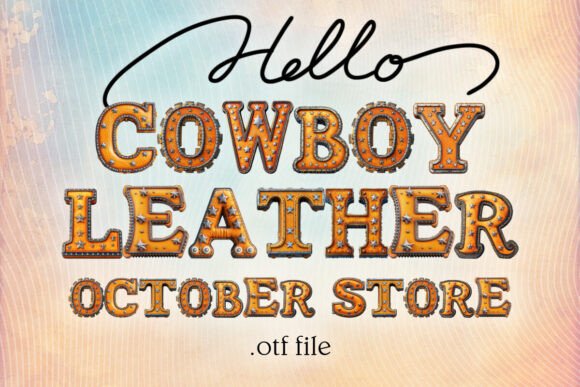
Discover the allure of the Wild West—not as cliché, but as craft. Cowboy Leather Alphabet delivers rich, layered color fonts with visible grain, subtle stitching details, and weathered edges that suggest time, care, and origin. It reads as rustic yet refined, bold but not aggressive, and handmade without sacrificing polish. For local business owners, that duality is gold: it signals authenticity to customers while still supporting professional branding. Think farm-to-table spice blends, small-batch hot sauce labels, or vintage-inspired children’s toy packaging—brands where story and substance are inseparable.
Where It Shines in Real Small Business Design
This isn’t a font for body copy or ingredient lists. It’s a strategic accent—a visual signature. In practice, Cowboy Leather Alphabet excels in:
- Product labels — especially front-of-pack hero text (e.g., “SMOKED MAPLE SYRUP” on a maple syrup bottle)
- Packaging accents — foil-stamped lettering on kraft soap boxes or embossed hang tags for boutique apparel
- Thank-you cards and stickers — adding warmth and personality to post-purchase touchpoints
- Seasonal campaign visuals — think “HARVEST NIGHT MARKET” banners for a local florist’s fall pop-up
- Social media graphics — Instagram carousel headers, limited-edition launch announcements, or Etsy shop banners
- Printable inserts — recipe cards tucked inside food product packaging or care instructions for handmade ceramics
Used intentionally, it strengthens first impression, lifts shelf appeal, and deepens emotional connection—especially for customers seeking locally made, values-driven goods.
Where to Use It With Intention (Not Just Decoration)
Like any strong design asset, Cowboy Leather Alphabet gains power through restraint. Avoid using it:
- In formal corporate branding (e.g., law firms or accounting services)
- On very small labels—under 12pt at print size, detail loss becomes noticeable
- Over busy backgrounds or low-contrast surfaces (e.g., tan text on beige kraft paper)
- In ingredient-heavy layouts where clarity trumps character
- Alongside luxury minimalist brands that rely on negative space and typographic silence
The moment decoration competes with function—like obscuring a net weight statement or muddying legal disclaimers—it undermines trust instead of building it.
Practical Designer Notes You’ll Actually Use
Before locking in Cowboy Leather Alphabet for client work or your own product line, run these checks:
- Test it on real packaging mockups—not just digital previews. Print a label at actual size and hold it beside competitor products.
- Check black-and-white usage: Does the outline remain distinct if color fails (e.g., in grayscale printing or screen reader previews)?
- Preview it on small labels: At 8–10pt, does the leather texture read as charm—or clutter?
- Test it with your brand colors: Some color fonts shift hue depending on background; verify consistency across your palette.
- Compare it beside serif, sans serif, script, and handwritten pairings: I paired it beautifully with a warm, open sans (like Poppins) for Sage & Saddle’s secondary text—creating hierarchy without tension.
- Review SVG or vector editability: If you need to adjust spacing, recolor individual letters, or scale infinitely for signage, confirm native vector support.
- Verify commercial licensing: Ensure your use case—physical product labels, digital ads, Canva templates for resale—is explicitly covered. Not all color fonts include broad commercial rights.
More Than a Font—A Brand Identity Anchor
For local business owners juggling production, fulfillment, and customer service, every design decision must pull double duty. Cowboy Leather Alphabet does exactly that: it supports small business branding by reinforcing origin, craftsmanship, and regional pride—all in a single glyph. When used across product mockups, social media graphics, and printed marketing visuals, it creates consistency without repetition. Customers begin to recognize not just your logo—but your texture, your tone, your touch.
It also elevates perceived value. A candle brand using Cowboy Leather Alphabet on its jar label—paired with natural soy wax and hand-poured process language—doesn’t just sell scent. It sells belonging. That’s the quiet power of intentional graphic design assets: they turn transactional moments into relational ones.
Final Thought for Creative Entrepreneurs
If you’re a handmade business owner, boutique curator, or local food producer choosing design assets for your next launch, ask yourself: does this help customers feel where this product comes from—and who made it? Cowboy Leather Alphabet answers yes—not with gimmick, but with grounded, printable, commercially viable authenticity. It’s not just another font. It’s a storytelling tool, ready for real packaging, real shelves, and real people who choose local because they believe in place, people, and purpose.